My interest in teaching is twofold:
- Personal: Throughout my career, I have always loved the human-facing aspect of each different job. While strategic middle-management tasks (e.g. content planning, performance analysis) provide me with a sense of growth, dealing with people gives me a sense of fulfillment. As such, while trying to find the right balance between these two domains, I came upon teaching.
- Professional: I have always heard about how hard being a teacher can be, and that their work goes beyond the classroom (spoiler alert: those claims are true, and I am currently overwhelmed). So I intend to figure out how much technology can assist in teaching daily.
My observations so far, from the training period (class observations, early lesson planning) until the first month of teaching.
Teaching is an inherently human role:
- No amount of reading on pedagogy will make sense until you start meeting the actual students you are going to teach.
- To begin with, teaching children is already much more complex than, say, training fresh associates in a company. The children are in an intense period of growth, so what you need to understand about one grade (their stage of development, what they need, etc) can vastly differ from each other.
- Then you have to take into account the interplay between cultural context and the subject you are teaching. In my case, I am teaching BM to Malaysian kids who mostly speak English or Cantonese at home (and in some cases, expat kids). Questions will arise such as how do I incentivize them to want to learn Bahasa, in the first place? How do I make the lessons relatable to their experiences and what do they know about their world?
- This is also to say that the role of a teacher is so inherently human and is most unlikely to be replaced by AI any time soon.
- Or, to look at it from the opposite POV, there’s much work to be done in terms of training AI to better understand our specific linguistic and cultural context.
Lesson planning with AI:
- I have been using Claude as my main tool, for lesson planning and everything else; and ChatGPT only for image generation. It started that way because Claude had (has?) the biggest context window, and then it became a personal preference, simple as that.
- Claude has been a lifesaver in terms of lesson planning. You can have a big idea of what to do for the year/week/day (or brainstorm it together with Claude), and then have Claude fill out all of the details.
- Which makes you adaptable to changes. Because you WILL have to change – lesson plan fails, the energy of the classroom fluctuates, your energy fluctuates. But at least you won’t have to rewrite, line by line, all the dialogues you’ve prepared for the kids to role-play.
- In that regard, I’m still treating Claude as a highly competent assistant rather than a fellow leader. To put it in Star Trek lingo, Claude is more of a prodigal ensign than it is a Chief Engineer (or perhaps that is my limitation cause I can’t think like Picard yet).
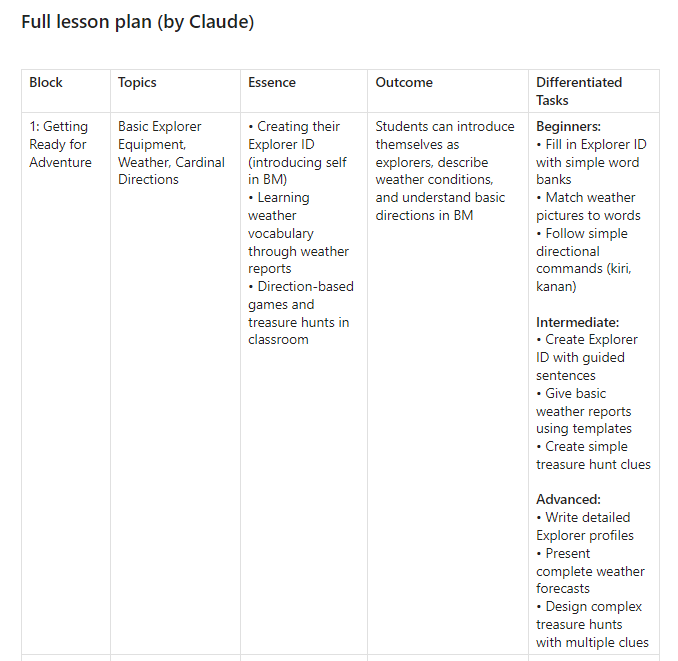
Image generation with AI:
- This is part of lesson planning, but it deserves a special sub-section because I don’t know how to draw, to begin with, and Dall-E has been another lifesaver.
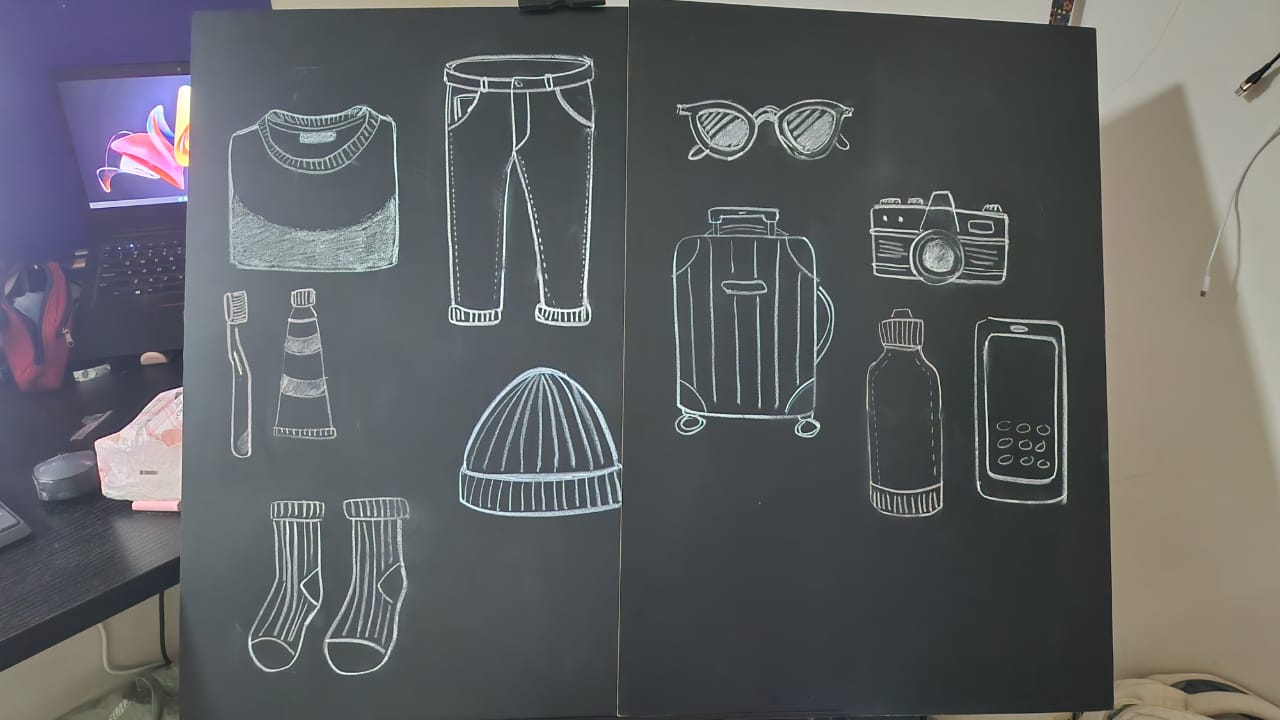
- I am incorporating a lot of imaginative and pictorial approaches in my lessons, so I’ve been asking Dall-E (included in ChatGPT Plus) to generate ideas and sketches that I can copy onto a physical form.
- I am not up-to-date with the latest in image generators, but I remember my small problem with them during the early days was how their prompts tended to be specific to each app. When Dalle-E 3 came out, OpenAI promised the prompt to be more natural and that’s what I’m holding them out for.
- Another factor is cost. Being a teacher is by definition, being broke. I can only afford one premium subscription at a time, so I chose to use Claude Plus and pinjam my wife’s ChatGPT Plus account for Dall-E.
- (I can also do a local installation of Stable Diffusion, but with my laptop specs I would have to wait an hour for each prompt)
…and tech stops before the class starts:
- I am teaching middle school (Grade 4, 5, and 6), so I am encouraged to write my lessons on the blackboard, instead of as a typed printout. And I’m not even there yet! My handwriting is terrible so I prepare my materials (on small blackboards, papers) in advance.
- This means that there are a lot of manual preparations that can’t be automated by AI. Not because AI can’t do so, but because these children need to see and model after their teachers – from listening, speaking, reading, and writing.
- Again, the role of a teacher is so inherently human.
- Thankfully, I found a lot of joy in prep work. In the first week, I was hyper-focused way past midnight to get ready for the next day. Not until my wife was rushed into the ER and then ICU on the last day of the week that I learned something that is also very human…
That we, the teachers, are an equally important half of the equation:
- Week 2 and 3 were brutal. With the daily hospital run (and a real fear that my spouse might die), I was often exhausted and unprepared for my classes. I started doubting whether I was good enough for the job. One kid said out loud, “This class is so boring” before trying to persuade me to belanja them to McD – which I made her do so in BM, so mission’s accomplished, I guess.
- Yet, if I am to choose between being exhausted and prepared vs being rested and unprepared, it will always be the latter. Because no matter how prepared you are, any slightest deviation will throw you off the track when you are insomnia-laden, and you won’t be able to be fully present for the children.
- Conversely, you can roll with the punches much better when you have had enough sleep the night prior. And I hope this adaptiveness will just get better through experience.
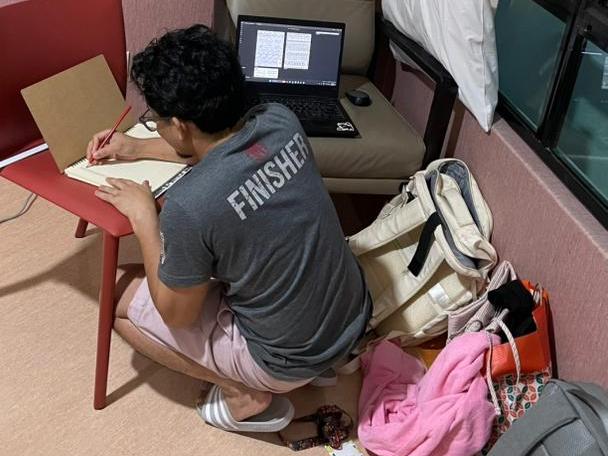
Ok lah itu je buat hari ini. Boy, am I grateful for the school holiday so I can rest and recover physically, mentally, and emotionally. Selamat CNY semua, moga panjang umur murah rezeki, tengs.
Meta
Originally written on February 2025